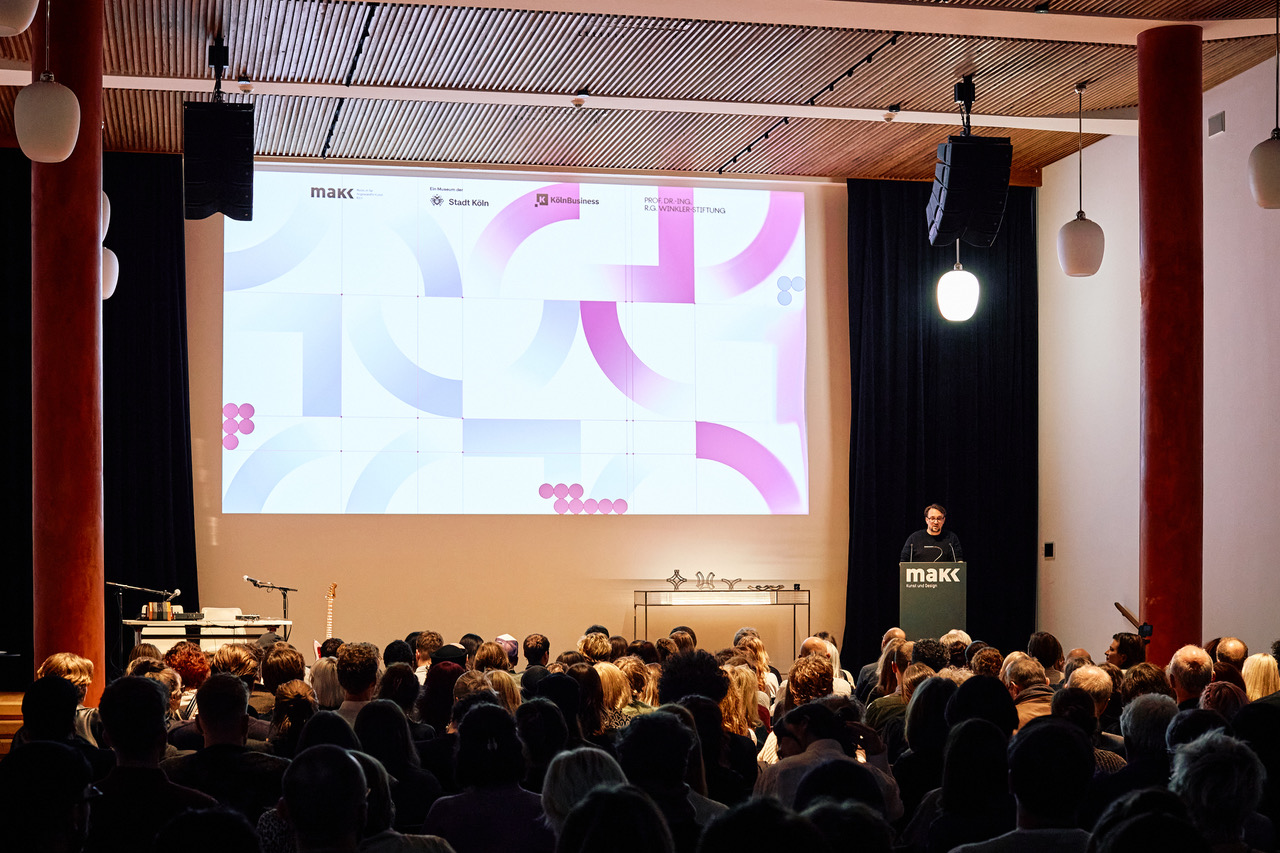
Last November, I was invited to give a short address at the Cologne Design Award ceremony — an occasion that brought me back to the city where I started as a design student, now almost fifteen years ago. Fifteen years isn't a lifetime, but it's enough to span the arc from a world where the iPhone hadn't launched yet to one shaped by algorithmic mediation of nearly everything. Standing in front of a room full of graduates, I tried to reflect on what has changed since then, what this might mean for design education – and more specifically, for those entering the field right now. What follows is an attempt to take the central questions of my talk a bit further: to articulate, more precisely, some of the challenges that design graduates face today, and to ask what literacies those challenges demand.
A note on the word "challenges," before I begin. It can easily sound like crisis management: identify the obstacle, heroically overcome it, move on. That's not what I mean. What I describe here are structural conditions, tensions that won't resolve themselves, that shape the terrain on which any meaningful design practice has to be built. They are, if you like, the weather. You don't solve weather. You learn to read it and to dress for it.
The narrowing entry
Let's start with what's most immediately felt: The structural conditions for entering design practice are tightening. AI and automation are compressing the space that entry-level positions traditionally occupied, the execution-heavy work that used to be a way in. Certainly, these systems are opening genuinely exciting possibilities for design work: new tools, new scales of operation, new forms of creative practice that barely existed two years ago. But the entry problem remains, because those possibilities tend to reward people who already know what they're doing, not those just starting out. Meanwhile, budgets are tightening across the board — in culture, research, and the public sector, but also in companies that are investing cautiously and trimming what they consider essential. The cost of living in the cities where most of this work happens continues to rise.
If you're graduating now, there is a real tension between the kind of thinking your education has prepared you for and what most available entry points actually look like. And it contains a genuine dilemma: it makes no sense for design education to focus on automatable skills, as that would be preparing for a world that's already disappearing. But having strategic, critical, and systemic competencies doesn't mean you walk straight into a strategic position. You have to start somewhere, and that somewhere may not look like what you trained for. This isn't a failure of education or ambition — it's a structural condition that calls for strategies: a kind of economic realism that doesn't slide into cynicism about whether meaningful work is possible at all, the ability to distinguish between a compromise and a capitulation, and resourcefulness in constructing viable arrangements like freelance combinations, hybrid roles, or cross-subsidising meaningful work through adjacent employment.
But the narrowing entry has a deeper dimension, too. It's not just about jobs. It's about the question of where, concretely, you can do the kind of work that matters to you. It's worth noting that this question has more answers today than it did a decade ago — designers now work as strategists, as transformation managers, as creative technologists, often in roles that didn't have names when they started studying. The paths exist, but they are rarely straight, and they almost never start where you'd expect.
Identity without a template
Design has never been a discipline with clear boundaries, and that, as I'll argue later, is genuinely a resource. But for someone entering professional life, disciplinary blur is first and foremost an identity problem. You sit in job interviews where nobody knows what you can do, and you can't yet explain it well yourself. The categories on job platforms don't tightly map onto what a contemporary design education actually equips you for, and the task of translation is real: explaining to an NGO what "design research" means, to a tech company why speculative design is not a hobby, to your family why you're not just making things look pretty. Each of these registers is different, and none of them can be faked.
This connects to a broader tension. There is a strong pull, especially early in a career, toward resolving ambiguity as quickly as possible: picking a lane, committing to a label, performing certainty. Social media amplifies this: everyone else seems to have figured it out. Meanwhile, the design discourse demands reflexivity, criticality, complexity. The result is a double bind: the market wants legibility, the discipline wants nuance, and you need to eat.
The temptation is to resolve this by choosing a side: becoming either the cynical professional who doesn't ask questions, or the permanent critic who never ships anything. Both are dead ends. The literacy here, it seems to me, is ambiguity tolerance, but not as passive endurance. Rather, as an active capacity to commit to a direction without pretending it's the only one. A habit of regularly checking whether you're still heading where you want to go — without requiring that you always know exactly where that is.
The political stakes
Design is never neutral. Every design decision materialises certain possible futures and forecloses others. This has always been true, but it becomes more pressing when the political stakes of everyday decisions about platforms, data, public space, and access are visibly rising. Yet much of design culture still operates as if good intentions and a vaguely progressive worldview were sufficient — and I don't think they are. What's often missing is not political awareness but the willingness and ability to articulate what relations we actually want to produce through our work — to ask, concretely, for whom or against what we are designing.
This translates into a practical demand: you will make things with political implications, whether the brief frames them that way or not. The outcome of your "service innovation" will be a redistribution of attention, access, or agency. The question is not whether you act politically (you do, inevitably) but whether you develop the capacity to reflect on it. And reflection here means more than awareness: it means articulating what critique of the present your work builds on, and what vision of the future it serves.
But what vision of the future, exactly? This is where the challenge deepens, and where I find it hardest to speak without either drifting into cultural pessimism or retreating into empty optimism. The sociologist Andreas Reckwitz describes an ontological dimension to the sense of loss that pervades contemporary (western) societies: not only material losses (inflation, precarity, shrinking welfare) but the erosion of the very frameworks through which we made sense of the world. The progress narrative that carried modernity — the belief that we were moving, more or less, toward greater freedom and prosperity for all — has come apart. What replaces it is not a new story, but a vacuum, populated by disorientation, exhaustion, and the authoritarian movements (left and right) that feed on both.
I find Reckwitz's perspective helpful because it clarifies why the core business of design, imagining and materialising futures, feels increasingly precarious. It's not just that the problems have gotten bigger. It's that the cultural conditions for imagining better futures have themselves eroded. You are being asked to be future-oriented in a moment when the future has become a site of anxiety rather than aspiration. This doesn't make the work impossible, but it would be dishonest not to acknowledge that it changes what that work can claim to do. And yet, designing something — an object, a process, a space — is always, implicitly, a claim that things could be otherwise. A working proposition for change, however modest. This calls for the ability to work with situated, provisional futures rather than grand narratives — and for a critical relationship to solutionism, that reflex to frame every situation as a problem awaiting the right intervention.
Allies, peers, and the infrastructure of collegiality
Design has unprecedented access to spaces where it was never traditionally invited: public administration, healthcare, policy-making, research, social innovation. The expanded understanding of what design can contribute has opened doors. But walking through them requires the ability to operate in other people's professional logics without surrendering your own.
You will work with sociologists, engineers, civil servants, activists, educators, all of whom have their own expertise, vocabularies, and standards of rigour. The worst thing you can do is arrive as the "creative person" who will fix everything with sticky notes; the second worst is to defer entirely to their framing and become a service provider with no perspective of your own. What's needed is translation competence, genuine curiosity, and the confidence to push back when design's contribution is being undervalued. In fact, this capacity to move between professional worlds, to learn their logics and let yourself be changed by them, is something design's openness as a discipline uniquely allows. It's also one of the genuine rewards of the work: some of the most formative professional relationships you'll build are with people who think nothing like you, and who sharpen your own perspective precisely because of that.
But there's another dimension to this that gets less attention: the relationships that form not across disciplines, but within your own cohort. Professional life after graduation is structurally imagined as an individual trajectory: your portfolio, your career. But the friendships and partnerships formed during a shared educational experience are among the most consequential resources you carry with you. These aren't networking contacts. These are people who have seen your work evolve, who share a language and a history, who understand what you're trying to do because they were there when you figured it out.
Some will become collaborators, co-founders, sounding boards, or simply the person you call when you doubt whether any of this makes sense. But this doesn't happen automatically. It requires genuine investment — showing up for other people's work, being generous with knowledge, staying in touch when it's no longer convenient. And it requires the practical capacity to initiate structures that outlast the institution, whether that's a shared studio, a reading group, a loose collective, or a regular check-in. Collegiality, understood this way, is not a soft skill — it's infrastructure, and it needs to be built deliberately.
Agency, craft, and the question of what you can do
There's a word that comes up constantly in design discourse: impact. Along with transformation, systemic change, paradigm shift, it's a vocabulary that implies significant leverage over outcomes. But the reality of entering the profession is often sobering: you have no budget, no name, no institutional mandate. The challenge is not to lower your ambitions but to develop a realistic sense of how change happens — and what role you can play at this stage. Most meaningful change comes not from brilliant interventions but from sustained presence, building trust, recognising small openings, being useful in ways that gradually expand your scope. This is not a consolation prize — it's how things actually work, and the literacy it calls for is something like strategic patience: knowing when to push and when to build the ground that makes pushing possible later.
And then there is craft. The expanded understanding of design as research, facilitation, and systemic intervention is essential. But it carries a risk: that breadth comes at the expense of depth, and that "thinking like a designer" displaces the ability to make things at a high level. AI complicates this picture in both directions. It commoditises competent-but-generic execution, whether that's a layout, a wireframe, a stakeholder map, or a research summary, which means that merely solid craft is no longer enough. But it also amplifies what a skilled designer can do: it extends reach, accelerates iteration, and makes entirely new forms of practice possible. The question is shifting from "what can I do that a machine can't" to "how do I work with these tools at a level that goes beyond what the tools can do alone?" That requires depth — a craft pushed far enough that it becomes a form of thinking in itself. And it requires breadth, because breadth is what gets you into the room in the first place, even if depth is what earns you respect once you're there.
Literacies, not solutions
I've used the word "literacies" throughout, a term central to this platform's work, but one worth being precise about in this context. What I mean here are capacities that can be developed through practice, reflection, and exposure, rather than personality traits or innate talents. The question is not "do you have these?" but "how do you build them?" — and that question is itself a design challenge.
None of this is meant as advice from a safe distance. I've navigated many of these tensions myself, with varying degrees of grace, and I continue to. What I've come to trust, though, is an idea that shaped my own formation as a designer: that our disciplinary blur is not a deficiency to be overcome but a resource to be embraced. Sure, if you'd studied medicine or law, it would be easier to explain at Christmas dinner what exactly it is you do. But that's a price worth paying, because the most productive stance toward one's own professional role is one of serious play — experimenting with what you can be, staying curious about what's happening beyond the familiar edges of the discipline, and doing this not in isolation but as part of a network that acts together.
The world out there is large and full of things we can learn from and ally ourselves with. There is no reason to limit our scope to the inherited job descriptions of design or the innovation bubble. The challenges I've outlined here are real, and I don't think it helps to pretend otherwise. But they are also, in a sense, an invitation: to come back to that idea of serious play, and to take the design of one's own role as seriously as any other design challenge. I've tried to name these tensions as clearly as I can, but they can't be resolved in the abstract. They take shape differently in every practice, every context, every career. What I would welcome is the conversation that follows: where others recognise themselves in these tensions, where they don't, and what they would add.
Image: Cologne Design Prize ceremony, MAKK Cologne, November 2025. © KISD FotoAG